




High-Speed Small Rocket UAV: Features and Advantages
In the rapidly evolving landscape of unmanned aerial vehicles, a new category has emerged that pushes the boundaries of speed, agility, and structural integrity: the High-Speed Small Rocket UAV. Inspired by the aerodynamic principles of rocket design and constructed from advanced materials, these drones represent the pinnacle of performance engineering. Designed for applications ranging from competitive racing to high-speed reconnaissance, the High-Speed Small Rocket UAV combines the aesthetics of a missile with the intelligence of a modern drone. This article explores the defining characteristics that set this class of UAV apart.
1. Rocket-Inspired Aerodynamic Design
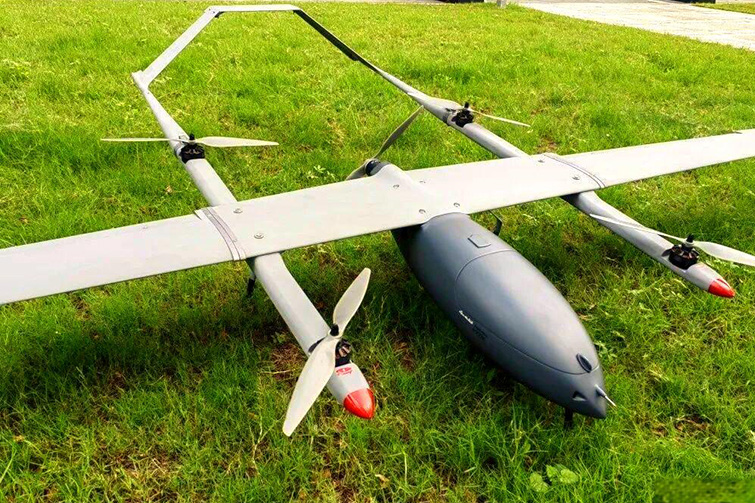
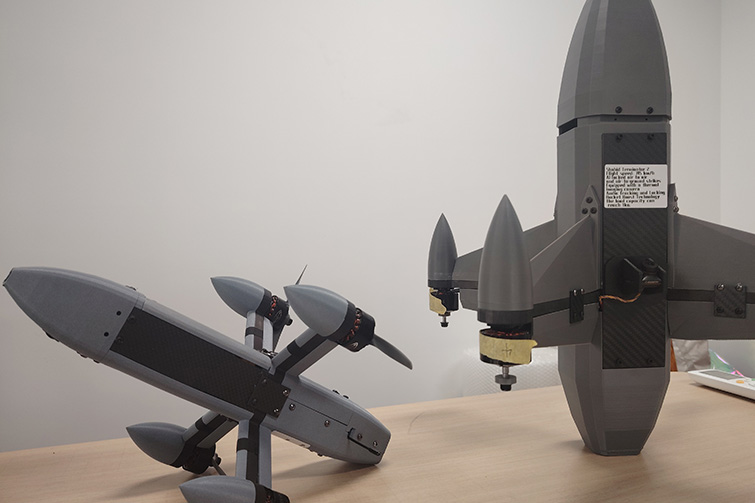
The most striking feature of the High-Speed Small Rocket UAV is its aerodynamic configuration. Unlike traditional multirotor or conventional fixed-wing drones, this platform adopts a streamlined, rocket-like fuselage. The design minimizes drag—the primary obstacle to achieving high speeds—allowing the aircraft to slice through the air with minimal resistance.
Every contour, from the nose cone to the tail section, is meticulously engineered to optimize airflow. The result is an aircraft that not only achieves remarkable straight-line speeds but also maintains stability during high-G maneuvers. This aerodynamic efficiency is essential for applications such as competitive racing, where milliseconds matter, and for rapid-response scenarios where reaching a target quickly is paramount.
2. High-Performance Carbon Fiber Airframe
To realize the demanding performance targets of a high-speed UAV, the choice of materials is critical. The High-Speed Small Rocket UAV features an airframe constructed entirely from high-performance carbon fiber composites. This material selection offers several distinct advantages:
- Exceptional Strength-to-Weight Ratio: Carbon fiber provides the structural rigidity required to withstand the immense aerodynamic forces encountered at speeds exceeding 400 km/h, all while maintaining an incredibly lightweight construction. A lighter airframe translates directly to faster acceleration, higher top speeds, and improved maneuverability.
- Superior Stiffness: The high modulus of carbon fiber ensures that the airframe does not flex or deform under load. This rigidity is crucial for maintaining precise control and aerodynamic efficiency at high speeds.
- Impact Resistance: Despite its lightweight nature, carbon fiber offers excellent impact resistance. This durability is vital for a high-performance aircraft that may operate in challenging environments or experience hard landings.
- Fatigue and Corrosion Resistance: Carbon fiber maintains its mechanical properties over time, resisting environmental degradation and ensuring long-term reliability even with repeated high-stress flights.
3. Uncompromising Speed and Agility
The hallmark of this UAV is its exceptional speed. Capable of reaching maximum flight speeds of up to 400 kilometers per hour, the High-Speed Small Rocket UAV ranks among the fastest production drones available. This velocity opens up a range of applications where time is critical:
- Competitive Racing: In the world of drone racing, speed is everything. This UAV’s rocket-inspired design gives pilots a competitive edge on the track.
- Rapid Response: For emergency services and security applications, the ability to deploy a high-speed drone to a location in minimal time can be a game-changer.
- High-Speed Reconnaissance: Military and defense applications benefit from the UAV’s ability to quickly cover ground and perform high-speed surveillance passes.
Beyond straight-line speed, the UAV is engineered for agility. The combination of a rigid carbon fiber airframe, precisely tuned control surfaces, and a powerful propulsion system enables sharp turns, rapid climbs, and stable flight even in turbulent conditions.
4. Extended Endurance and Stability
While speed is a primary focus, the High-Speed Small Rocket UAV does not compromise on endurance. The aerodynamic efficiency of the rocket-inspired design reduces drag, allowing the aircraft to achieve longer flight times than many other high-speed platforms. Depending on the configuration and battery selection, operators can expect sustained flight durations suitable for mission-critical tasks.
Stability is another key attribute. The advanced flight control system, combined with the inherent stability of the airframe, ensures smooth and predictable flight characteristics even at high speeds. This stability is essential for applications such as aerial cinematography, where capturing usable footage requires a steady platform, and for industrial inspection, where precision loitering is necessary.
5. Versatile Application Capabilities
Despite its specialized design, the High-Speed Small Rocket UAV is remarkably versatile. Its features make it suitable for a broad spectrum of applications:
- Aerial Mapping and Surveying: The speed and endurance allow for rapid coverage of large areas, reducing mission time compared to slower platforms.
- Emergency Rescue: In search and rescue operations, the UAV can quickly locate individuals over vast areas and relay real-time video to ground teams.
- Industrial Inspection: The UAV can inspect power lines, pipelines, and infrastructure with speed and efficiency, minimizing downtime for critical assets.
- Competitive Racing and Freestyle: For enthusiasts, the platform offers an exhilarating flying experience with unparalleled speed and responsiveness.
- High-End Scientific Research: Researchers can utilize the UAV for atmospheric studies, wildlife tracking, and other applications requiring high-speed data collection.
6. Integration of Advanced Avionics
The High-Speed Small Rocket UAV is equipped with sophisticated avionics to support its performance capabilities. This includes:
- High-Precision Flight Controller: Capable of handling high-speed flight dynamics and providing features such as GPS waypoint navigation, return-to-home, and fail-safe protection.
- Real-Time Telemetry: Operators receive continuous data on speed, altitude, battery status, and system health.
- High-Definition Video Transmission: For FPV (First Person View) applications, low-latency video transmission allows pilots to fly immersively at high speeds.
Conclusion
The High-Speed Small Rocket UAV represents a convergence of advanced materials, aerodynamic excellence, and intelligent engineering. With its carbon fiber airframe, rocket-inspired design, and top speeds of 400 km/h, it stands at the forefront of high-performance drone technology. Whether deployed for competitive racing, rapid-response missions, or industrial applications demanding speed and efficiency, this UAV delivers uncompromising performance. For operators seeking a platform that combines the thrill of high-speed flight with the reliability of modern drone technology, the High-Speed Small Rocket UAV is an exceptional choice。